
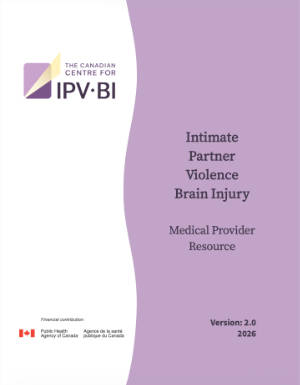
This resource is for physicians and nurse practitioners. This resource is intended to support clinical assessment and management. It is not designed for survivors to diagnose or treat themselves, or as a general information resource for other audiences.
If you are a survivor looking for information, start with the Survivor’s Guide to Brain Injury.
Clinical practice guidelines exist for concussion and brain injury, but few specifically address the needs of patients experiencing intimate partner violence (IPV). These patients may present with repeated head trauma, other physical injuries, possible brain injury related to oxygen deprivation, and safety concerns that shape clinical assessment and care. The Intimate Partner Violence Brain Injury Medical Provider Resource is a preliminary clinical resource, developed by clinicians, researchers, and advocates to help address this gap. Version 2.0, published in 2026 and adapted from the 2023 original, outlines an approach to in-office assessment, initial management, and medical follow-up for patients with acute intimate partner violence-caused brain injury (IPV-BI).
What the resource covers
- Types of brain injury associated with intimate partner violence. Understand concussion, structural brain injury, and hypoxic-ischemic injury associated with non-fatal strangulation.
- Co-occurring injuries and conditions. Consider other head and bodily injuries, alongside features of mental health conditions, that may affect assessment and care.
- Initial clinical assessment. Review patient-specific considerations, clinical history, physical examination, and supplemental testing.
- Initial management and medical follow up. Explore considerations for care and ongoing clinical monitoring.
Clinical decision-support tools. Use the summary table of assessment considerations, referral considerations table, and clinical algorithm to support clinical decision-making.
Developed by a multidisciplinary team
This resource brings together expertise from clinicians, researchers and advocates affiliated with the University of Manitoba, BC Children’s Hospital and the Concussion Awareness Training Tool, KITE-Toronto Rehabilitation Institute and the University of Toronto, the Icahn School of Medicine at Mount Sinai, Wilfrid Laurier University, the University of Utah, the University of British Columbia-Okanagan, Klinic Community Health, Fraser Health, WomenatthecentrE and Supporting Survivors of Abuse and Brain Injury through Research (SOAR).
Using and citing this resource
The resource, including its figures and tables, may be used and adapted without permission, provided the following citation is included:
Canadian Centre for IPV-BI: Intimate Partner Violence-Brain Injury Medical Provider Resource (Version 2.0), 2026.
The recommendations in it are considerations, not directives. Physicians and nurse practitioners should apply their own clinical judgment and account for the needs of each patient and the context of their practice.
Access the full resource
Download the full PDF to review the clinical considerations, assessment tools, referral guidance and clinical algorithm.
Download the full resource (PDF)
Supporting Survivors of Abuse and Brain Injury through Research (SOAR) is a registered charity and the only Canadian organization dedicated to intimate partner violence-caused brain injury. Through research, education and advocacy, we turn evidence into action.