
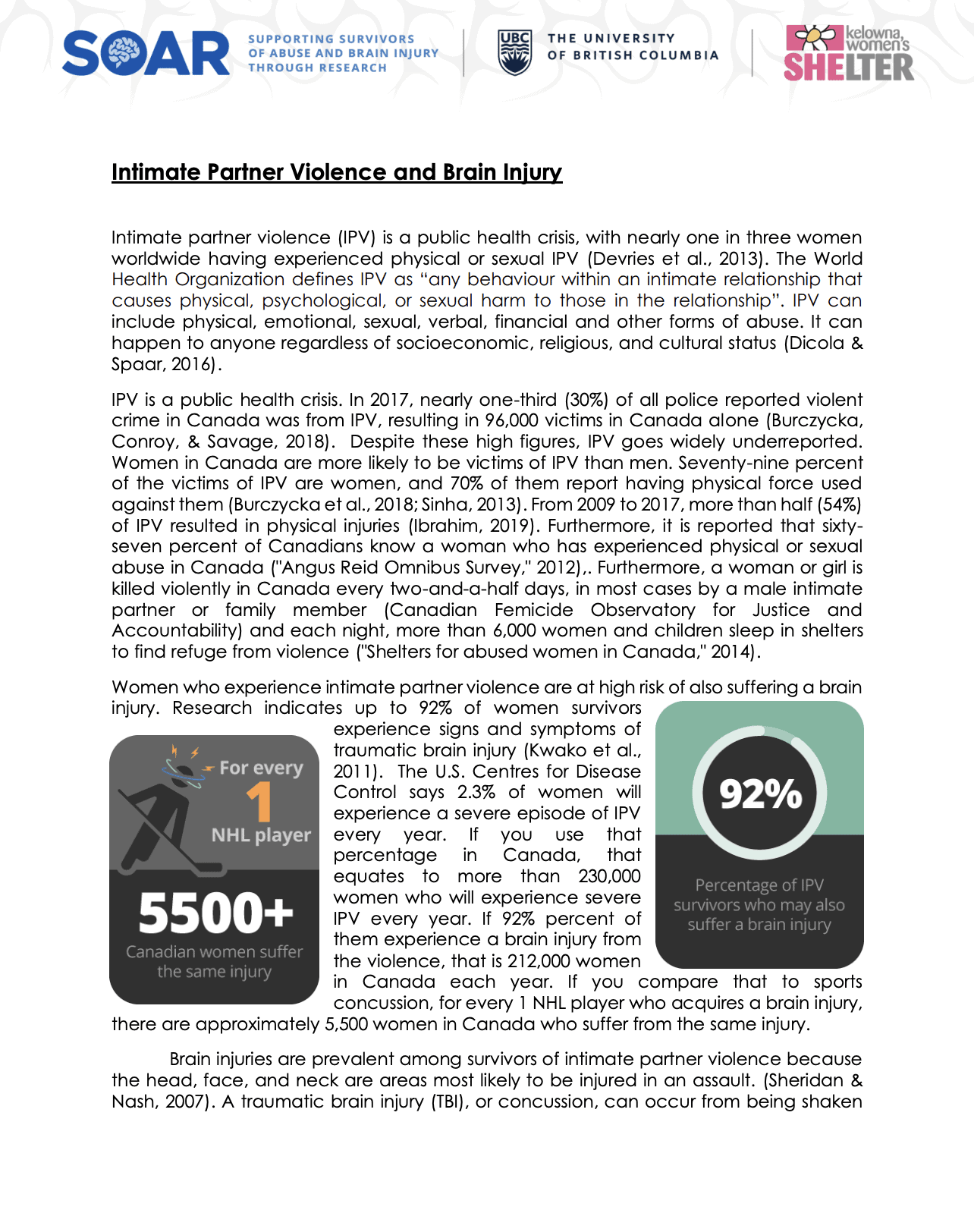
Nearly half of women in Canada face some form of intimate partner violence (IPV) in their lifetime. Research indicates up to 92 per cent of women survivors have signs of a brain injury.
The Intimate Partner Violence and Brain Injury: Fact Sheet sets out the evidence on intimate partner violence-caused brain injury (IPV-BI), including key statistics, risk factors, and the links between abuse and brain injury. Every figure is sourced, making this a practical reference for funders, journalists, students, policymakers, healthcare professionals, and organizations that support survivors.
What the fact sheet covers
- The prevalence of intimate partner violence in Canada. Explore Canadian and global statistics on intimate partner violence and intimate partner violence-caused brain injury, including police-reported violence and femicide. Did you know one in three women worldwide has faced physical or sexual violence from a partner? Or that in 2017 intimate partner violence accounted for 30 per cent of all violent crime reported to police in Canada. That is about 96,000 people in one year?
- Who is most affected. Understand the disproportionate rates of violence experienced by women, including Indigenous women in Canada, who face violence at nearly three times the rate of other women.
- How abuse causes brain injury. Learn how blows to the head, face and neck, as well as strangulation and smothering can cause brain injury.
- The risks of strangulation. Discover what research tells us about loss of consciousness, strangulation, and the increased risk of future lethal violence.
- The cumulative effects of repeated injury. Athletes get time to heal between injuries. Women living with ongoing abuse often do not. Understand why ongoing abuse can leave survivors with repeated brain injuries, worsening symptoms, and decreased opportunities for full recovery.
Understanding the scale of intimate partner violence-caused brain injury
For every brain injury suffered by a National Hockey League player, an estimated 5,500 women in Canada experience a similar injury caused by an intimate partner.
This comparison highlights the scale of intimate partner violence-caused brain injury, a serious but often overlooked consequence of intimate partner violence.
The fact sheet also connects readers with national resources from Women’s Shelters Canada, Brain Injury Canada, and Parachute.
Download the fact sheet
Access the evidence, explore the sources, and use the findings to inform your research, reporting, advocacy, or work supporting survivors. Supporting Survivors of Abuse and Brain Injury through Research (SOAR) is a registered Canadian charity and the only Canadian organization dedicated to intimate partner violence-caused brain injury. Through research, education and advocacy, we turn evidence into action.